


US Military Strikes Against Islamic State in Syria
In a significant display of military might, the US military has conducted a series of airstrikes targeting over 30 Islamic State (IS) positions in Syria. This operation is a direct response to a deadly ambush that claimed the lives of two US soldiers and an American civilian interpreter two months prior.
Operation Hawkeye Strike
The recent strikes, which took place from February 3 to February 10, are part of a broader military campaign under the codename Operation Hawkeye Strike. This initiative is aimed at maintaining relentless pressure on the remnants of the IS terror network, which continues to pose a significant threat in the region. During this period, the military successfully targeted weapons storage facilities and crucial IS infrastructure through ten sophisticated airstrikes.
Precision Airstrikes
According to US Central Command (CENTCOM), these air operations utilized precision munitions deployed from various aircraft, including fixed-wing, rotary-wing, and unmanned drones. This multi-pronged approach ensures that targets are eliminated with minimal collateral damage, showcasing the capability and tactical expertise of the US military.
Response to Attacks
The escalation in military action follows a deadly encounter in Palmyra on December 13, where IS fighters launched a surprise attack on US and Syrian forces. During this ambush, two US sergeants—Edgar Brian Torres-Tovar and William Nathaniel Howard—along with interpreter Ayad Mansoor Sakat, lost their lives. The strategic implementation of Operation Hawkeye Strike is a response not only to these tragic losses but also to continue dismantling IS operations that threaten the stability of the region.
Impact of Recent Operations
Throughout the last two months, the US military campaign has resulted in the deaths or captures of over 50 IS terrorists and the neutralization of more than 100 IS targets. Such operations emphasize the ongoing commitment of the US and its allies to eradicate the threat posed by IS, even as it continues to evolve in response to military pressures.
Transfer of IS Prisoners
In another development closely tied to the US military’s campaign, recent news has surfaced regarding the transfer of thousands of IS prisoners from Syria to Iraq. This process is seen as a crucial step in holding accountable those involved in terrorist activities and is expected to ease the burden on Syrian detention facilities.
The Role of Al-Tanf Base
Simultaneously, reports confirm that Syria’s military has reclaimed control of the Al-Tanf military base. This area, previously operated by US forces as part of the coalition effort against IS, plays a vital strategic role in the broader context of the fight against Islamic extremism in the region.
The Legacy of IS
IS’s influence peaking in 2014 marked the declaration of a caliphate across large swathes of Syria and Iraq. The imposition of radical Sharia law led to widespread suffering and instability. However, through coordinated international efforts led by US forces, the caliphate was dismantled, although remnants of the group continue to wage guerrilla warfare against local and international forces.
The Future of the Campaign Against IS
As military operations continue and countries like Iraq prepare for the trial of IS detainees, the landscape of counter-terrorism remains complex and fraught with challenges. The recent military actions illustrate the US military’s ongoing commitment to combating extremist groups, ensuring that global threats do not escalate unchecked.
Photo Reference
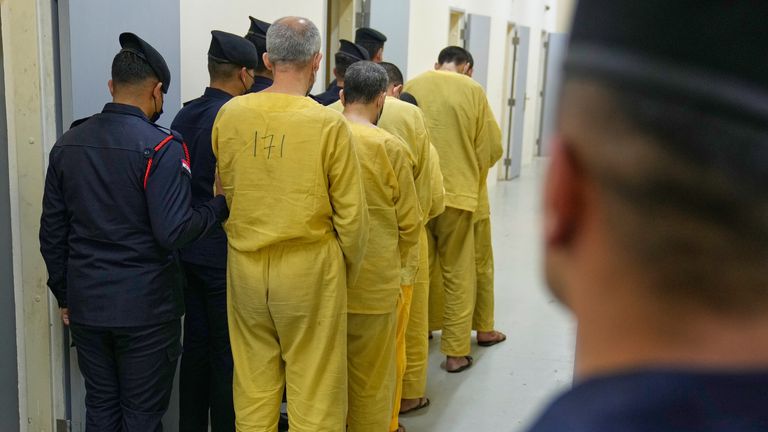
Thousands of suspected IS fighters were moved from Syria to Iraq. Pic: AP
In this climate of uncertainty and conflict, the actions of the US military in Syria represent a broader commitment to maintaining regional stability and combating terrorism at its roots.